Showing posts with label Spain. Show all posts

Thursday, 12 September 2019

My Work on Mark Wright's Mendoza Ancestor for 'Who Do You Think You Are?' UK

I'm thrilled that I can finally share some details of an intense few weeks this past Spring squirrelling away in the shadows on the family history of Don Antonio de Mendoza. The resulting research was part of the story presented last night on the British edition of Who Do You Think You Are? 

In his ancestor's footsteps: Mark Wright (l.)
David Mendoza, who appears on screen in the programme, had uncovered much valuable information about his and Mark Wright's shared ancestor; my contribution was essentially to locate more records and to document minute, hitherto unknown details of Antonio's life. Antonio de Mendoza was a tough customer: his career as a fencing master and his later tenacity in getting around an inquisition-imposed travel ban to seek safety in Amsterdam already provided ample evidence of this, but I was thrilled to discover that earlier he had been a 'Guardia de Millones', a sort of armed revenue officer who protected tax money collected for the King. Most of his swashbuckling exploits are lost to us, but it surely speaks volumes how he stated that if forced upon release to remain in Seville unarmed, he would face retribution from a thug whose face he had once slashed in the course of fighting off a robbery, and who had sworn revenge! Also to Antonio's credit, he wasn't a snitch. During two years in an Inquisition dungeon, imprisoned and tortured, he never gave evidence against any of the associates and family members the Inquisitors pulled in after his arrest - as the Inquistion's civil servants noted in his case file, to their increasing frustration.
 
Mark Wright and his family were clearly touched by Antonio's story. As a genealogist their reaction delighted me, it's the most encouraging response to hours spent squinting at faded pages in poorly heated archives!

Antonio's tribulations will stay
A record bundle I used in this research
with me, among the more memorable cases on which I'veworked; as will the agony of certain other poor souls, contemporaries of his who suffered at the hands of the same loathsome Inquisitors. Two such items I came across among the many pages turned in search of Antonio were the sad tale of the Santander sisters, five young women imprisoned in Seville at the same time as Antonio, for practicing Judaism covertly, and whose only brother cracked during imprisonment and testified against them; and a memo, found among papers of the Madrid inquisition from 1680, noting that someone needed to be engaged to clean out the cage in which the condemned were being burned alive, as unburnt bones were accumulating among the ashed at the bottom. Once again, routine paperwork illustrating the banality of evil.


Sunday, 11 October 2015

Heraldry in a Phantom Tube Station

Visitors to Madrid who tour the phantom tube station at Chamberí will find some artistic items of heraldic interest. As the guide explains, when the station was first opened in 1919 the firms who sponsored its construction were rewarded with space for permanent advertisements on the walls adjoining the platforms. In the remainder of the stations on Line 1 of the Madrid underground, such adverts have long since been covered over or destroyed, but when Chamberí station, closed in 1966, reopened as a museum in 2008, several of its original tile advertisements were restored to their full glory, as seen here.


The station is open for a few hours daily on Friday, Saturday and Sunday; its hours and other information may be found at the following link: http://www.metromadrid.es/en/viaja_en_metro/anden_0/index.html

Thursday, 30 October 2014

Spanish Heraldic and Genealogical Manuscripts Available Online

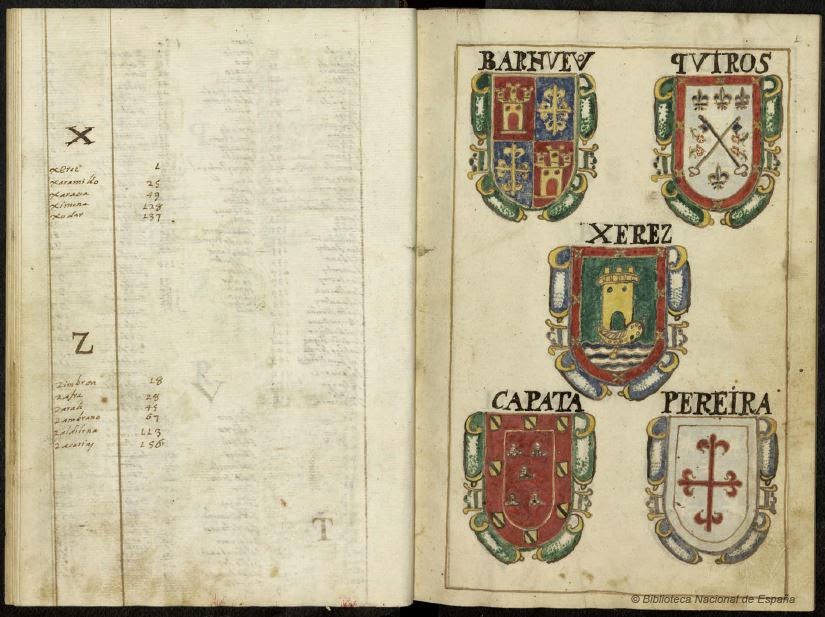
A valuable and, I believe, still little-known resource for Spanish heraldry and genealogy online are the manuscripts digitised through the Spanish National Library's 'Biblioteca Digital Hispánica' subsite, the number of which has grown steadily over the past couple of years. This site offers a veritable treasure trove of Spanish heraldic and genealogical manuscripts of diverse periods and provenance, and - it must be said - diverse quality as well. Given the dispersal of the records and registers of grants made by officers of arms under the Spanish crown, this collection may be the closest thing the nation has to the archives of London's College of Arms.

The site's use is straightforward enough; there is room for improvement in the cataloging and one senses that many Spanish antiquaries and even heralds have fallen into complete obscurity, a topic I have previously discussed with certain heraldists in my acquaintance and which is a striking contrast to the relative prominence still enjoyed today in our circles by their English counterparts of long ago, such as Dugdale. For example, they date a manuscript compiled by one Diego de Soto y Aguilar as 'Between 1700 and 1800?' when a quick Google places him at court in the reigns of Felipe III and Felipe IV, that is, the first half of the 1600s.

To sift through some of the manuscripts now available through this site simply go to http://bdh.bne.es/bnesearch/, click on Advanced Search and then fill in Heráldica or Genealogía as subjects, tick on the box for Manuscripts (see example here) and you're off to the races. If you're familiar with sites such as Gallica or Hathi Trust, this will seem comparatively easy to navigate, with thumbnails of each page appearing in a bar at the left as you go through each work.


Thursday, 18 September 2014

Heraldry and Genealogy in the town of Llerena


 This town in Spain's westerly Extremadura region was the venue for a wedding I recently attended and while there I found some very appealing heraldic display, ranging from these beautifully painted 16th century arms in one of the chapels at the Nuestra Señora de la Granada church, to these more modern painted tiles at the arrivals door of the bus station, showing the arms of the town and of the region.

Some years ago I had occasion to work extensively with 16th century records of both of Llerena's churches as well as the notarial records for the same period, a wealth of documents that revealed a great deal about the families then prominent in the city - Chaves, Silíceo, Oliveros and Larios, among others. I look forward to eventually adding the photographs I obtained of the many armorial stones adorning some of the town's venerable old houses and will surely find these lineages and others represented in them.

Wednesday, 10 September 2014

Ancestry of Juan Miguez, 18th-century settler of Attakapas and New Orleans

Juan Miguez, who settled in North America's Attakapas County in 1778 and subsequently resided in New Orleans, has been widely listed as a native of 'San Salvador de Febra' in the Spanish region of Galicia, but this seems certain to be the result of a transcription error in the published version of the will left by Juan in New Orleans in 1800. Another publication, which transcribes the list of those who sailed aboard the brig 'San Josef', repeats the Febra error but at least gets us a bit closer to the Miguez' actual point of origin, by adding the placename Tuy.

A survey of the parishes in the Diocese of Tuy yields no Febra, but given the similarity of the uppercase letters T and F in old script it seems to me almost certain that Juan must have been native to the parish of San Salvador de Tebra, in the province of Pontevedra. As José's parents are named in his will, and the diocesan records for the 1700s are today kept at the Diocesan Archive of Tuy, it seems that his ancestry is simply waiting to be discovered.


If anyone can advise me as to specifically which publication was the source of the published transcript of Juan's will, I will happily update the reference below.


SOURCES: Will of Juan Miguez, 1800, extract submitted by Maurine Bergerie to a publication unknown; 'Historia de Alhaurín de la Torre en la Edad Moderna, 1489-1812', by José Manuel de Molina Bautista, extract online at http://www.thecajuns.com/malaguenos%20in%20la.pdf


Monday, 25 June 2012

Posession is nine-tenths of the law?

Or so it would seem if disheartening heraldic snippets in the Spanish press are any indication. The onetime home of the Marqués de Campo Villar, in the Bécares area of the Spanish province of León, has for decades lain in ruins; indeed the area seems to have become depopulated in the 19th century. Yet the armorial stone bearing the Marqués' arms clung to the façade of the Campo Villar manor house - until recently. Local newspapers report that the stone has been roughly removed, and taken a short distance away; it seems that the reporter was even able to suss out the stone's current hiding place, and photograph it prone on a pallet. Why? Who knows. Perhaps it's heading for eBay?

The most recent of the articles ends with reference to assorted ownership disputes in the surrounding area: Bécares being depopulated, the lands of the Marqués and the Municipality seem to have been divided three ways in 1961, part of the land used for agriculture, part as a private boar hunting reserve and part ceded to the nearest inhabited town. None of these claims however provide grounds for the wanton ignorance of Spanish legislation governing the protection of such heritage goods - yet there seems to be no will or means to properly enforce these laws or care for the items. 
Before and After


Thursday, 10 May 2012

Felipe's your Boogie Man - er, bogeyman...

It seems ironic that as official disinterest - disdain, even - for family arms rules the day in many places, local and national arms in contrast receive a great deal of attention from the powers that be, and do so despite the financial crisis affecting most countries with heraldic traditions.

The latest news in this regard comes from Catalonia, where the royal coat of arms on the façade of the regional parliament is to be replaced with the arms of the Kingdom of Aragon. Barcelona daily La Vanguardia posted the image below showing what the façade looked like in 1932, what the armorial stone looks like now, and what it will look like after the substitution.

Spanish King Felipe V has long been a bogeyman in orthodox Catalan history for his role in abolishing Catalonia's ancient freedoms after the Catalans backed the losing side in the War of the Spanish Succession - for those unfamiliar with the Decretos de Nueva Planta, they were to the Catalans a bit like the 1707 Act of Union to Alex Salmond. 

That said, it's interesting that this decision is being spun as covering up the arms of Felipe V, rather than simply covering up the 'Spanish Royal Arms' or 'the arms of the King of Spain'. Despite this marketing strategy it seems unlikely that the timing is purely coincidental, given recent events such as the decision by the council of the catalan town of Berga to declare King Juan Carlos persona non grata after his recent hunting mishap. But of course, King Juan Carlos' arms look nothing at all like those of his politically incorrect ancestor and predecessor on the throne, so as long as everyone's clear that it's not his arms being replaced, but those of a King who's been dead for 266 years, there shouldn't be any controversy.