Showing posts with label heraldry. Show all posts

Sunday, 11 October 2015

Heraldry in a Phantom Tube Station

Visitors to Madrid who tour the phantom tube station at Chamberí will find some artistic items of heraldic interest. As the guide explains, when the station was first opened in 1919 the firms who sponsored its construction were rewarded with space for permanent advertisements on the walls adjoining the platforms. In the remainder of the stations on Line 1 of the Madrid underground, such adverts have long since been covered over or destroyed, but when Chamberí station, closed in 1966, reopened as a museum in 2008, several of its original tile advertisements were restored to their full glory, as seen here.


The station is open for a few hours daily on Friday, Saturday and Sunday; its hours and other information may be found at the following link: http://www.metromadrid.es/en/viaja_en_metro/anden_0/index.html

Tuesday, 10 March 2015

Heraldry at Madrid City Hall's principal weddings room

Just found these pictures I took last year when a friend of mine married at Madrid City Hall's principal venue for such ceremonies, the ancient Casa de la Panadería in a square much loved by locals and tourists alike, Plaza Mayor. Perhaps surprisingly, only the Spanish arms - not Madrid's municipal coat - figure as fixtures in the room. The beautifully painted arms adorning the ceiling have obviously been there for a very long time, but I wonder if the heraldic tiles on one wall may have been brought there from elsewhere - the individual parts don't seem to line up very well!

Thursday, 30 October 2014

Spanish Heraldic and Genealogical Manuscripts Available Online

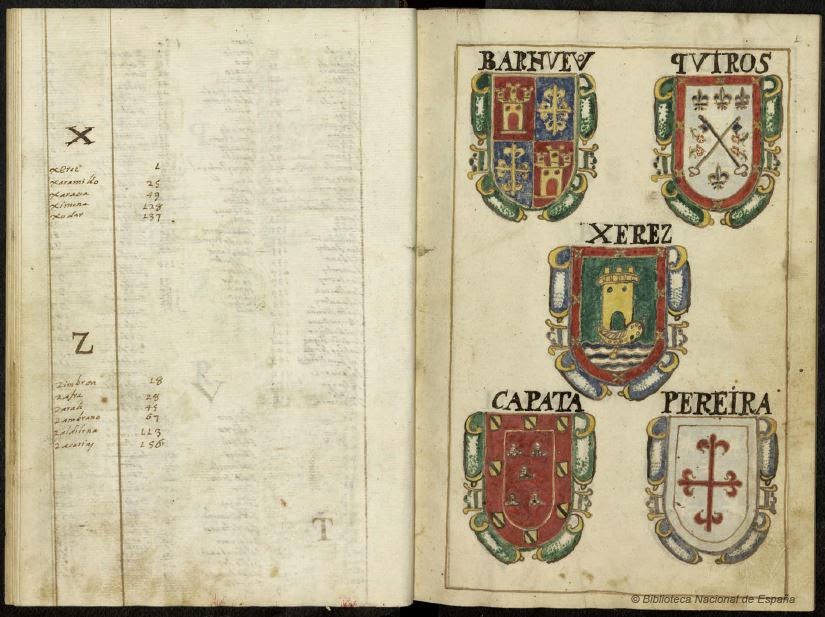
A valuable and, I believe, still little-known resource for Spanish heraldry and genealogy online are the manuscripts digitised through the Spanish National Library's 'Biblioteca Digital Hispánica' subsite, the number of which has grown steadily over the past couple of years. This site offers a veritable treasure trove of Spanish heraldic and genealogical manuscripts of diverse periods and provenance, and - it must be said - diverse quality as well. Given the dispersal of the records and registers of grants made by officers of arms under the Spanish crown, this collection may be the closest thing the nation has to the archives of London's College of Arms.

The site's use is straightforward enough; there is room for improvement in the cataloging and one senses that many Spanish antiquaries and even heralds have fallen into complete obscurity, a topic I have previously discussed with certain heraldists in my acquaintance and which is a striking contrast to the relative prominence still enjoyed today in our circles by their English counterparts of long ago, such as Dugdale. For example, they date a manuscript compiled by one Diego de Soto y Aguilar as 'Between 1700 and 1800?' when a quick Google places him at court in the reigns of Felipe III and Felipe IV, that is, the first half of the 1600s.

To sift through some of the manuscripts now available through this site simply go to http://bdh.bne.es/bnesearch/, click on Advanced Search and then fill in Heráldica or Genealogía as subjects, tick on the box for Manuscripts (see example here) and you're off to the races. If you're familiar with sites such as Gallica or Hathi Trust, this will seem comparatively easy to navigate, with thumbnails of each page appearing in a bar at the left as you go through each work.


Thursday, 18 September 2014

Heraldry and Genealogy in the town of Llerena


 This town in Spain's westerly Extremadura region was the venue for a wedding I recently attended and while there I found some very appealing heraldic display, ranging from these beautifully painted 16th century arms in one of the chapels at the Nuestra Señora de la Granada church, to these more modern painted tiles at the arrivals door of the bus station, showing the arms of the town and of the region.

Some years ago I had occasion to work extensively with 16th century records of both of Llerena's churches as well as the notarial records for the same period, a wealth of documents that revealed a great deal about the families then prominent in the city - Chaves, Silíceo, Oliveros and Larios, among others. I look forward to eventually adding the photographs I obtained of the many armorial stones adorning some of the town's venerable old houses and will surely find these lineages and others represented in them.

Monday, 14 October 2013

Recent updates - armorial.es - Actualizaciones Recientes

I have just added 15 entirely new pages to my armorial.es site, and updated the pages of 4 cities with photos of additional coats of arms.

Acabo de actualizar mi sitio armorial.es, añadiendo 15 páginas enteramente nuevas, y fotos adicionales para 4 ciudades más.

Saturday, 29 September 2012

The Arms of Robert Dow, Merchant Taylor of London (1517-1612)

Whilst in London last week I visited the City's historic church of St Botolph without Aldgate and admired its unique memorial to Robert Dow, Master of the Merchant Taylors in 1578 and a generous philanthropist. The only images of this memorial that I was able to find online focused - understandably - on the man himself; the arms of the Merchant Taylors' Company take pride of place atop the whole but at the bottom of this fine monument, and at something of an angle to the viewer, we find his arms as well, and I am pleased to share a photo of them. Dow's family seem to have been an armigerous lineage from Suffolk and his pedigree was recorded in the 1568 Visitation of London. 

The arms are clearly canting, but in view of this it's all the more surprising that there seems to have been so much confusion around the correct form of his surname, even in his lifetime. The published version of the Visitation - which, one hopes, faithfully reproduces the Herald's notes - give it as Dove, and biographical materials about him reference accounts of 'Robert Dove' as Collector of a subsidy. Yet the monument clearly refers to him as Dow. Strype's survey of London indicates that the initial marker, a brass plate erected by his family and heir, referred to him as Dow; but the more imposing monument that we see today, erected by the Merchant Taylors in the 17th century, makes it Dove again. One almost begins to wonder if the letter w was pronounced with a Germanic sound in Jacobean times! In any event, if one happens to be in the vicinity of Aldgate this memorial to a liveryman is well worth a look-in.

Monday, 16 July 2012

An heraldic surprise

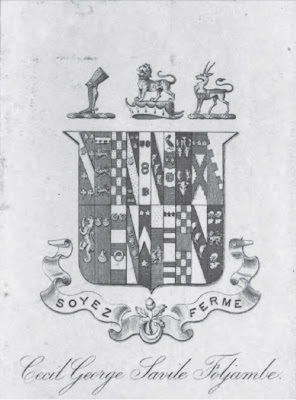
Upon downloading a copy of Granville Leveson Gower's Genealogy of the Family of Gresham from Google Books, I was pleased to spot this heraldic bookplate on the inside of the front cover. It was the bookplate of Cecil Foljambe, subsequently the 1st Earl of Liverpool of the 1905 creation. The book was published in 1883, and Foljambe did not become Baron Hawkesbury for another 10 years; I'm not a bookplate collector but I imagine any bookplates of his with the Earl's coronet would be quite rare, as he held the title for barely a year before his death.

Monday, 25 June 2012

Posession is nine-tenths of the law?

Or so it would seem if disheartening heraldic snippets in the Spanish press are any indication. The onetime home of the Marqués de Campo Villar, in the Bécares area of the Spanish province of León, has for decades lain in ruins; indeed the area seems to have become depopulated in the 19th century. Yet the armorial stone bearing the Marqués' arms clung to the façade of the Campo Villar manor house - until recently. Local newspapers report that the stone has been roughly removed, and taken a short distance away; it seems that the reporter was even able to suss out the stone's current hiding place, and photograph it prone on a pallet. Why? Who knows. Perhaps it's heading for eBay?

The most recent of the articles ends with reference to assorted ownership disputes in the surrounding area: Bécares being depopulated, the lands of the Marqués and the Municipality seem to have been divided three ways in 1961, part of the land used for agriculture, part as a private boar hunting reserve and part ceded to the nearest inhabited town. None of these claims however provide grounds for the wanton ignorance of Spanish legislation governing the protection of such heritage goods - yet there seems to be no will or means to properly enforce these laws or care for the items. 
Before and After


Thursday, 10 May 2012

Felipe's your Boogie Man - er, bogeyman...

It seems ironic that as official disinterest - disdain, even - for family arms rules the day in many places, local and national arms in contrast receive a great deal of attention from the powers that be, and do so despite the financial crisis affecting most countries with heraldic traditions.

The latest news in this regard comes from Catalonia, where the royal coat of arms on the façade of the regional parliament is to be replaced with the arms of the Kingdom of Aragon. Barcelona daily La Vanguardia posted the image below showing what the façade looked like in 1932, what the armorial stone looks like now, and what it will look like after the substitution.

Spanish King Felipe V has long been a bogeyman in orthodox Catalan history for his role in abolishing Catalonia's ancient freedoms after the Catalans backed the losing side in the War of the Spanish Succession - for those unfamiliar with the Decretos de Nueva Planta, they were to the Catalans a bit like the 1707 Act of Union to Alex Salmond. 

That said, it's interesting that this decision is being spun as covering up the arms of Felipe V, rather than simply covering up the 'Spanish Royal Arms' or 'the arms of the King of Spain'. Despite this marketing strategy it seems unlikely that the timing is purely coincidental, given recent events such as the decision by the council of the catalan town of Berga to declare King Juan Carlos persona non grata after his recent hunting mishap. But of course, King Juan Carlos' arms look nothing at all like those of his politically incorrect ancestor and predecessor on the throne, so as long as everyone's clear that it's not his arms being replaced, but those of a King who's been dead for 266 years, there shouldn't be any controversy.

Saturday, 28 April 2012

Everything Counts, in large amounts....

With Spanish unemployment hitting 25% - as much as 50% among those under 24 - and public officials under pressure to set an example of austerity, clearly there's never been a better time to spend public funds fiddling with a centuries-old heraldic device. The authorities of the ancient Castilian town of Carrión de los Condes have decided their arms need a makeover.

Escudo de Carrión de los Condes
If you're over 30 you'll remember the old Ghostbusters tag line, 'Who ya gonna call?' Well, apparently not the Chronicler of Arms for Castille-León, which is odd because if the decision's been made to adjust the arms come what may, this assignment would clearly seem to fall within his legal remit.

Instead, the city fathers privately commissioned an historical study and report, the salient conclusions of which were: the lion in the fourth quarter should be replaced with a castle, and a Royal crown should be substituted for that of a count presently found in the crest-coronet - an eminently sensible decision, given that the town's name literally means 'Carrion of the Counts'. The cost of these earth-shaking conclusions? €6,750 for the report, to which in time may be added the cost of replacing signs, stationery, and anything else unfortunate enough to bear the ancient version, presumably including the armorial stone that for centuries has graced the town hall. As a film this could be... 'Carry on, Carrión'!

Friday, 16 March 2012

Guano in Heraldry (II)

A snippet of heraldic news spotted today reminds me of the old cliché regarding buses: you wait for ages, then three come along at once. I certainly did not intend to reprise the topic of my previous post this soon, if at all...

Council authorities at Colmenarejo, near Madrid, have decided it's time to replace the town's coat of arms, which among their other qualities are meant to be canting as they depict a beehive, Colmena in Spanish. A variety of reasons are cited: the arms were not adopted under the terms of the regional law governing arms and emblems, they were the winning entry from a schoolchildren's contest... I suspect that the real reason for their imminent replacement lies in what one resident told a newspaper: "A few years back a fountain bearing an enlarged sculpture of the arms had to be withdrawn because of an unfortunate resemblance."

Unfortunate resemblance? Whatever can he mean?

Monday, 12 March 2012

Guano in Heraldry

Recently I've seen some heraldic proposals best dismissed as excrementitious, so I was delighted to learn of one coat of arms that seemed truly worthy of the term. In promoting an upcoming travel programme filmed in the village of Pozoblanco (which translates to 'White Well'), Andalusian Public Television mentions local lore stating that the town's name derives from a well which in time was covered with so much chicken, er, faeces that the stones appeared to be white, and that said well was depicted on the town coat of arms. A quick Google reveals that in other versions of the town's history not only chickens are held responsible, but other animals as well! 

By now I was quite curious as to what the coat of arms actually looks like; I found the official blazon signed by the mayor, which mentions the chicken and the well, but contains no scatological references. And Wikimedia hosts an image of the arms, as seen here, but this too seems to have been sanitised.

So it seems that when it came to depicting heraldically the full extent of the chicken's contribution to local history, Pozoblanco chickened out. Just as well really - if ever there were a case for the concept 'less is more'...

Wednesday, 1 February 2012

Heraldry of an Annulled Knight

One may wonder if there are any heraldic consequences to Sir Fred Goodwin's loss of his knighthood, a matter receiving a great deal of media attention today. I've not been able to find any reference to his having received a grant of arms and it may simply be that the great man was so busy in the years following 2004 that he had no time to petition for arms.

In any event, as he was a Knight Bachelor I believe the heraldic import of this turn of events would simply be that he loses the right to adorn depictions of his arms with the badge and ribbon appropriate to said honour. [The heraldic equivalent of a ceremony similar to Alfred Dreyfus' degradation as shown in a famous contemporary engraving - wonder if this could now be re-enacted outside RBS HQ in Gogarburn?]

Sadly, as I say I could find no illustration of Sir Fred's coat of arms from which to depict the removal of said ribbon and badge, so I've had to come up with my own. Not having had my second coffee of the day I cannot yet blazon the full achievement save for the central charge, an increasingly common one in austerity-era heraldry, a clutch of Pounds Squandered. Also I was unsure whether present heraldic practice makes a Baton Sinister or Bordure Gobony more appropriate so to be on the safe side I've used both, no doubt equally richly deserved.


Sunday, 20 November 2011

Del escudo de British Airways y la jurisdicción heráldica

El absoluto desamparo legal en que esta sumada la heráldica siempre me ha parecido hasta cierto punto consecuencia de un esnobismo a la inversa. La heráldica es percibida en ciertos sectores como algo exclusivo, minoritario, y por lo tanto - con contadísimas excepciones - los emblemas heráldicos no gozan de la protección dispensada bajo las leyes promulgadas por y para la mayoría.

Cierto es que la ciencia del blasón no facilita las cosas para brindar, ante su uso indebido, la misma protección a los escudos que a los logotipos comerciales. Simplemente por la infinidad de variaciones sutiles que pueden hallarse entre versiones de un mismo blasón, dibujados por dos artistas distintos. Pongamos por caso que uno fuera viticultor, que decidiera - como muchos - rotular las etiquetas del caldo propio con motivos heráldicos, y que el blasón elegido fuese: "Escudo Medio Partido y Cortado, 1º De Gules, una letra M mayúscula de Oro; 2º, de Azur, un ratón parado; 3º, de Oro, un cocodrilo de su color."

Si en base a este blasón, un artista le confeccionara el siguiente dibujo, no violaría el derecho de marcas (no digamos nada del buen gusto).

En cambio, por motivos obvios, esta representación - desde el punto de vista heráldico, igualmente válida - del blasón antecedente sí violaría la protección de marcas:


Pero aun en aquellos sitios - poquísimos - donde el vetusto blasón recibe algún grado de la protección dispensada a la humilde hamburguesa, las cosas no siempre son claras.

Como ha sido ampliamente difundido en los medios, British Airways ha recuperado su escudo para sus campanas publicitarias, y también ira colocándolo en los fuselajes de sus aviones.
 
Ahí sin embargo surge una interesante disyuntiva. La empresa se entiende, como indica su nombre, como la aerolínea de bandera BRITANICA, no solo inglesa. Sin embargo, su escudo ha sido certificado por los cronistas de armas ingleses, el College of Arms con sede en Londres. No ha sido, en cambio, matriculado ante la autoridad heráldica escocesa, el Lord Lyon. Que no es poca cosa, ya que el Lord Lyon tiene por ley auténticas garras dignas de su nombre, y ha podido pararle los pies hasta al millonario Donald Trump, cuando este pretendía engalanar los hoyos de un campo de golf que construya en Escocia con un escudo de dudoso orígen. Mr Trump que registre su escudo con el beneplácito de la autoridad competente, como toda persona física o legal escocesa.

Pareciera pues que además de poder multar a la empresa por cada avión de British Airways que aterrice en suelo escocés, el Lord Lyon podría además hacer algo equivalente a picar el escudo en una fachada, que en este caso me imagino podría ser borrarlos del fuselaje con aguarrás, o algo parecido.

Sin embargo, fuentes de entera solvencia (no, no lo digo por el aguarrás) me dicen que de hecho no contempla decir nada. ¿Por qué? Pues porque en muchos círculos se considera cada vez más probable un referéndum sobre la independencia escocesa, que a medio plazo tenga la disolución del Reino Unido como consecuencia; a saber cómo, en ese caso, se llamaría British Airways, pero en todo caso no parece probable que la opción elegida sea ¡Scottish Airways! Los aviones pasarían de ser aviones "British", que técnicamente incumplen en parte normativa heráldica de su país, a ser aviones extranjeros y no por tanto sujetos a la legislación heráldica escocesa. La dialéctica entre Edimburgo y Londres ya de por si es bastante amarga; acaso sea mejor no echar mas leña al fuego y tirarse los escudos a la cabeza, sino dejar que los acontecimientos resuelvan la cuestión.

Wednesday, 2 November 2011

An Insult Rampant quartering an Affront Displayed

Moves to 'Disneyfy' Austria's embarassingly belligerent coat of arms may follow on the heels of this campaign to modify the country's national anthem, as perceptively noted by Austrian MP Carmen Gartelgruber. It won't do to persist in offending everyone in Piedmont, Moravia or any other territory long ago overrun by Austrians. This campaign to 'update' national symbols mirrors a wave of heraldic alterations requested or enacted in the last few years, the most recent of which is presumably that launched in Flanders.

One wonders if, having successfully emasculated national and local arms, those who fret about such things will move on to personal arms as well. Are French visitors to Blenheim Palace perhaps offended by seeing the French fleur-de-lys in an escutcheon on the Duke of Marlborough's arms? Off with his augmentation! Caribbean islanders may demand that any reference to their islands be removed from the Columbus coat of arms, or better still that the whole be simply painted blood-red as a mark of shame.
Arms of the city of Putnok (Hungary)
And the heraldry of other countries, such as Spain and Hungary, is no doubt replete with opportunities for hurt feelings; Hungarian heraldry in particular displays a distressing profusion of severed Turks' heads, for no better reason than that the entire country was once actually overrun by, and subsequently reconquered from, the Turks - can't have that!

A coat of arms may be based upon any number of rationales: it may represent what a lineage or an individual stands for, decisive moments in national or family history, or a personal interest or accomplishment of the first bearer - to the extent that one can even learn the rationale for the most ancient ones, passed down unquestioningly for so many generations that the original meaning is now a mystery. Of course, such inmutability does not mesh well with the modern trend to stand for nothing, to pliantly turn whichever way the wind blows, and to conform to ever greater homogeneity so that we all eat, read, wear and watch the same things. It seems then that if carried to its logical conclusion heraldic tampering will eventually require that the arms of all persons, regions and nations be strenuously refined to the point of not possibly offending anyone anywhere. I leave you with the following inspiring example of the New Heraldry:


Friday, 21 October 2011

A Call to ARMS

A few years ago I had occasion to visit an art exhibit of some sort in the crypt gallery of London's church of St Pancras. Quite what the exhibit was eludes me; it proved less memorable than the variety of broken armorial funeral monuments spread rather haphazardly around the crypt. I don't know whether these monuments were formerly inside the church itself, or had been in the crypt and were shunted to one side to make way for the more modern attractions. One particularly fine specimen featured highly detailed palm trees and some sort of tropical motif, perhaps alluding to service by the deceased in some far-flung corner of the Empire; alas, it had been broken into more than one piece so I could not photograph it fully assembled.

Sadly, I do not have as many opportunities to haunt crypts as I would like, so I cannot say if many armorial monuments come to this sort of distressing end. One fears though that they may, and wishes that there were some sort of museum or repository where such unwanted heraldic art could be displayed and enjoyed - the Armorial Refuse Museum, or ARMS for short?


Thursday, 13 October 2011

Heraldry abhors a vacuum

One hesitates to give such folderol wider distribution than it has already received; but the ignorance regarding matters heraldic displayed by one Alex Singleton, an obscure journalist who happens to have the disproportionately large platform that is the Daily Mail's website, can only be stamped out through efforts to re-educate.
http://singletonblog.dailymail.co.uk/2011/10/is-this-the-silliest-most-pointless-government-body-ever.html

The level of knowledge displayed in this post is not much beyond what a schoolboy could hastily produce if suddenly asked to write an essay on some topic previously unexplored by him. That schoolboy level of reasoning is further underscored by Mr Singleton's subsequent re-tweeting of someone else's comment that he placed the existence of Lyon Court on the same level of 'Uganda banning farts'. Subtle and perceptive indeed.

There's probably no harm in continuing to let Mr Singleton wallow in his own ignorance, which should keep him busy for quite some time; but lest some other heraldic novice should come across his opinion and mistake it for an authoritative one, rather than the chaff that it is, one observation. Did he give so much as a moment's thought to the chaotic situations that can develop in the absence of a proper regulatory framework for heraldry? Heraldry, like other human creations, is subject to abuse, misuse, exploitation and deceit. Some nations have venerable bodies whose authority is apparent even to the uninitiated, such as the Court of the Lord Lyon; others, such as some continental countries, at least have varying degrees of regulation governing the proper procedure for assuming a coat of arms, with registration and publication requirements analogous to those for commercial trademarks. Where there is no authority whatsoever, that is, in Mr Singleton's Shangri-La, the stage is set for, at best, confusion; and at worst, sterile disputes over who can fill the vacuum, dodgy practitioners selling arms to the gullible - on the basis of dubious credentials - and a free-for-all proliferation of poorly designed arms or such obvious misuse of others' arms as to constitute copyright infringement if it were to occur in trade. If, as the saying goes, a liberal is a conservative who's been arrested, then a heraldic anarchist such as Mr Singleton must have little actual experience of the situations such a vacuum creates. Ignorance is bliss.

Sunday, 9 October 2011

Recent updates - armorial.es - Actualizaciones Recientes

I recently added entirely new pages, or a few new photos, to my armorial.es site. The new material covers coats of arms found on buildings in the following Spanish localities:

Antequera · Chinchón · Guadalajara · Huesca · La Almunia de Doña Godina · Lucena · Madrid · Navalcarnero · San Cristóbal de la Laguna · Tarazona · Torrelaguna · Tuy 

Hace poco actualicé mi sitio armorial.es, añadiendo según el caso páginas enteramente nuevas o algunas fotos adicionales. Las novedades cubren escudos en las fachadas de edificios de todas las localidades españolas arriba nombradas. 

Thursday, 6 October 2011

Lecture at the AIG Colloquium, Bologna

Recently attended the VIIth International Colloquium of Genealogy organized by the Académie Internationale de Généalogie (AIG) in Bologna from September 26th through 29th, 2011. It was wonderful to have the chance to swap with fellow professionals stories (occasionally, horror stories) regarding research experiences 'in the field'. Some very interesting lectures - here are two shots of the setting before my own, delivered on the last morning in the inspiring neoclassical atmosphere of the Palazzo dall'Armi-Marescalchi. My topic was the forgery of proofs of nobility in Aragonese infanzonía litigation, and in particular the nuances of intent behind the creation of such forgeries.