Thursday, 30 October 2014

Spanish Heraldic and Genealogical Manuscripts Available Online

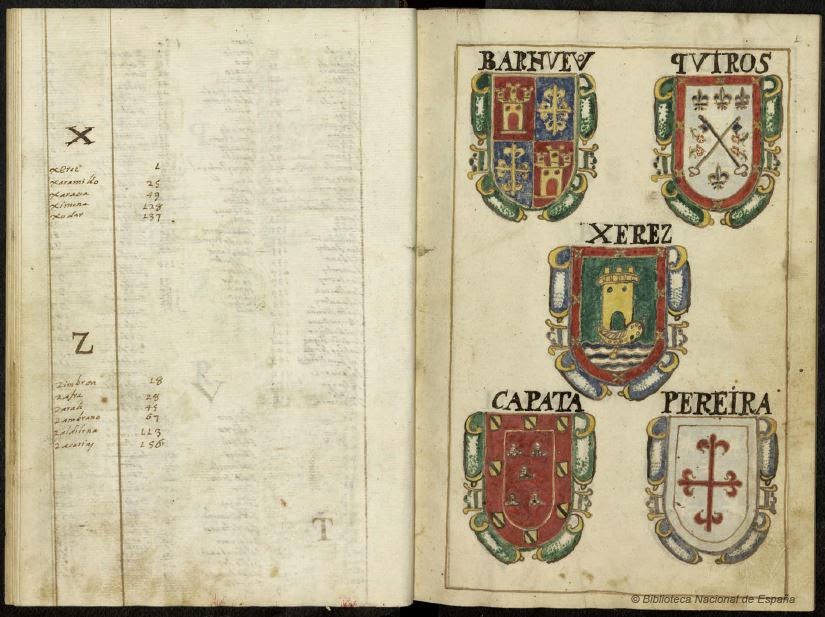
A valuable and, I believe, still little-known resource for Spanish heraldry and genealogy online are the manuscripts digitised through the Spanish National Library's 'Biblioteca Digital Hispánica' subsite, the number of which has grown steadily over the past couple of years. This site offers a veritable treasure trove of Spanish heraldic and genealogical manuscripts of diverse periods and provenance, and - it must be said - diverse quality as well. Given the dispersal of the records and registers of grants made by officers of arms under the Spanish crown, this collection may be the closest thing the nation has to the archives of London's College of Arms.

The site's use is straightforward enough; there is room for improvement in the cataloging and one senses that many Spanish antiquaries and even heralds have fallen into complete obscurity, a topic I have previously discussed with certain heraldists in my acquaintance and which is a striking contrast to the relative prominence still enjoyed today in our circles by their English counterparts of long ago, such as Dugdale. For example, they date a manuscript compiled by one Diego de Soto y Aguilar as 'Between 1700 and 1800?' when a quick Google places him at court in the reigns of Felipe III and Felipe IV, that is, the first half of the 1600s.

To sift through some of the manuscripts now available through this site simply go to http://bdh.bne.es/bnesearch/, click on Advanced Search and then fill in Heráldica or Genealogía as subjects, tick on the box for Manuscripts (see example here) and you're off to the races. If you're familiar with sites such as Gallica or Hathi Trust, this will seem comparatively easy to navigate, with thumbnails of each page appearing in a bar at the left as you go through each work.


Monday, 29 September 2014

Genealogical Oddities (XXXVII): A 19th Century Walloon Buried in Galicia

«Igrexa parroquial de Santiago do Carril-Vilagarcía de Arousa-Galicia-32» de Luis Miguel Bugallo Sánchez (Lmbuga) - Trabajo propio. Disponible bajo la licencia Creative Commons Attribution-Share Alike 3.0 vía Wikimedia Commons - http://commons.wikimedia.org/wiki/File:Igrexa_parroquial_de_Santiago_do_Carril-Vilagarc%C3%ADa_de_Arousa-Galicia-32.jpg#mediaviewer/File:Igrexa_parroquial_de_Santiago_do_Carril-Vilagarc%C3%ADa_de_Arousa-Galicia-32.jpg
The burial registers of the parish of Santiago de Carril, in the municipality of Villagarcía de Arosa, record the burial there on 25 December 1886 of 'Miguel Brayer Thonard', aged 65, a native of Ans in the province of Liège, Belgium, son of Pedro Miguel Brayer and Margarita Thonard. His marital status is said to be unknown; he is described as an 'Industrial', ie. a factory owner or other sort of manufacturer. I assume the French form of these names would have been: Michel Brayer (or Breyer?); Pierre Michel Brayer and Marguerite Thonard. Perhaps someone in Belgium knows who he was and why he was in Galicia.
SOURCE: Diocesan Archive of Santiago de Compostela, Registers of the Parish of Santiago de Carril, Burials 1879-1900, P. 87 verso

Thursday, 18 September 2014

Heraldry and Genealogy in the town of Llerena


 This town in Spain's westerly Extremadura region was the venue for a wedding I recently attended and while there I found some very appealing heraldic display, ranging from these beautifully painted 16th century arms in one of the chapels at the Nuestra Señora de la Granada church, to these more modern painted tiles at the arrivals door of the bus station, showing the arms of the town and of the region.

Some years ago I had occasion to work extensively with 16th century records of both of Llerena's churches as well as the notarial records for the same period, a wealth of documents that revealed a great deal about the families then prominent in the city - Chaves, Silíceo, Oliveros and Larios, among others. I look forward to eventually adding the photographs I obtained of the many armorial stones adorning some of the town's venerable old houses and will surely find these lineages and others represented in them.

Wednesday, 10 September 2014

Ancestry of Juan Miguez, 18th-century settler of Attakapas and New Orleans

Juan Miguez, who settled in North America's Attakapas County in 1778 and subsequently resided in New Orleans, has been widely listed as a native of 'San Salvador de Febra' in the Spanish region of Galicia, but this seems certain to be the result of a transcription error in the published version of the will left by Juan in New Orleans in 1800. Another publication, which transcribes the list of those who sailed aboard the brig 'San Josef', repeats the Febra error but at least gets us a bit closer to the Miguez' actual point of origin, by adding the placename Tuy.

A survey of the parishes in the Diocese of Tuy yields no Febra, but given the similarity of the uppercase letters T and F in old script it seems to me almost certain that Juan must have been native to the parish of San Salvador de Tebra, in the province of Pontevedra. As José's parents are named in his will, and the diocesan records for the 1700s are today kept at the Diocesan Archive of Tuy, it seems that his ancestry is simply waiting to be discovered.


If anyone can advise me as to specifically which publication was the source of the published transcript of Juan's will, I will happily update the reference below.


SOURCES: Will of Juan Miguez, 1800, extract submitted by Maurine Bergerie to a publication unknown; 'Historia de Alhaurín de la Torre en la Edad Moderna, 1489-1812', by José Manuel de Molina Bautista, extract online at http://www.thecajuns.com/malaguenos%20in%20la.pdf


Saturday, 30 August 2014

Genealogical Oddities (XXXVI): A Powell family from London in 19th Century Galicia

On 12 Dec 1817 in the city of Orense, at its church of Santa Eufemia la Real, took place the baptism of Carlota Josefa Luisa, daughter of Don Bernardino Losada, an administrator with Spain's Tobacco distribution network, and his wife Doña Luisa Powell. The infant's maternal grandparents were named as Don Basilio Powell and Doña María Croston, natives of London, England, and who then resided in the parish of Santiago in the city of La Coruña. Unfortunately, this child died in February 1821.

I have never come across this Basil Powell and Mary Croston in records of the city of La Coruña, which is perhaps a bit surprising as I have worked with records of all of its parishes many times. That said, the above records does not specifically say that their daughter Louise Powell was born in la Coruña, or even elsewhere in Spain, so the Powells may simply have come over after the Peninsular War, bringing one or more adult children with them.

SOURCE: Baptisms 1816-1835, P. 24 verso, Parish of Santa Eufemia la Real, city of Orense; at the Archivo Histórico Diocesano de Ourense.

Friday, 28 March 2014

Genealogical Oddities (XXXV): A British Birth in 19th Century Galicia

On 16th July 1825 at La Coruña's parish of San Jorge, a child born on the 3rd of that month was Christened with the names Juan Carlos. His father was John Peters of Bristol; his mother, Mary Tellet of London. The infant's paternal grandparents were named as John and Jane Peters, which presumably reflects the grandmother's married name; but the maternal grandparents were named as Joseph Tellet and Mary Stillman. This baptism is a bit unusual in that what one usually sees in Spain at this period are foreign bachelors who settled here and married a Spanish wife; in this case, the Peters' seemed to have moved to Spain as a family, for whatever reason, and one wonders if their son Juan Carlos Peters stayed in Spain or eventually set off for England.

SOURCE: Diocesan Archive of Santiago de Compostela, Parish of San Jorge of La Coruña, Baptisms 1823-1832, P. 129 verso

Wednesday, 12 March 2014

Genealogical Oddities (XXXIV): A 19th century British Major's Spanish Daughter

On 21 July 1813 at the garrison parish of San Fernando (then known as Isla de León) near the city of Cádiz, a girl named María Rosa Dolores was baptised. Born on the 2nd of that month, she was stated to be the daughter of Doña María Josefa Vitini, native of Cádiz; and of George Wilkinson, 'Comandante' of His Britannic Majesty's Artillery, whose origin is given only as 'England'.

Peninsular War buffs or Wilkinson family historians may perhaps know more precise details of this Major George Wilkinson to whose service record the above achievement may be added!

SOURCE: Military Parish of San Francisco, San Fernando-Isla de León, Baptisms 1812-1815, Page 85o; Navy Museum Archive, Madrid.