Sunday, 30 November 2014

Genealogical Oddities (XL): A Scots Nobleman in Spanish Service

By Celtus (Celtus @ english wikipedia) [CC-BY-SA-3.0 (http://creativecommons.org/licenses/by-sa/3.0)], via Wikimedia Commons
19th Century Spanish records document the interesting history of a branch of the distinguished family of Arbuthnott. A gentleman by the name of Jaime Arbuthnot y Arbuthnot was training for the priesthood in Spain when the Peninsular War erupted. In British Liberators in the Age of Napoleon, Dr Graciela Iglesias Rogers speculates at his origin, and 'perhaps illegitimate birth into an aristocratic family as well'. Certainly James Arbuthnot could simply have hispanicised his first name as Jaime; the use of one's mother's surname after the father's is conventional but was not mandatory in his day. In underscoring the fact that his mother too was an Arbuthnot, James perhaps alluded to an even darker secret than illegitimacy.

Whatever the truth regarding his origin, James left the seminary and served with distinction under the Spanish colours. The Spanish Army holds a service record referring to Jaime Arbuthnot y Arbuthnot - as he spelled the surname - as a Field Marshal, and states that he was born in Edinburgh on 24th December 1791, and died in La Coruña on 16th June 1863. It further describes him as being of noble birth. James, or Jaime as he was always called in Spain, married a lady named María de los Dolores Zuazo, a native of the Andalusian town of Puerto Real, and they had at least three children: 
  • Jaime, born in Saragossa on 7th September 1834, who became a Commander in Spain's paramilitary Guardia Civil and married twice: first to Emilia Beinet y Bonset, on 22nd December 1861; secondly, to Juana Salord y Escudero, on 10th October 1867; 
  • Matilde, baptised at Logroño's church of Santa María la Redonda on 26th July 1836; and 
  • Federico, baptised at Barcelona's church of San José on 27th June 1841, at which time his father was stated to be a Brigadier of Infantry and Colonel of Spain's 'Regimiento de América'. 
This last record names the child's paternal grandparents as Sir William Arbuthnott and María Ana Arbuthnott, both natives of Edinburgh; and these are also the parents attributed to James in his own military record.

One wonders if this data is enough to allow a researcher knowledgeable in contemporary Scottish families to link James and his Spanish descendants to the greater Arbuthnott tree. I cannot see, from materials presently availiable online, that this has been done.

SOURCES: Graciela Iglesias Rogers, British Liberators in the Age of Napoleon: Volunteering under the Spanish Flag in the Peninsular War, P. 13; General Military Archive, Segovia, Personnel files of Jaime Arbuthnot y Arbuthnot and Jaime Arbuthnot y Zuazo; Army Ecclesiastical Archive, Madrid, Book 198 [America Infantry Regiment, 1st Batallion, Sacramental Records 1828-1843], P. 19 verso

Wednesday, 12 November 2014

Genealogical Oddities (XXXIX): An 18th Century Irish Marriage in Cadiz

On 27 October 1751, at the chapel in Cádiz' La Carraca arsenal, Diego Conway (ie., James Conway), native of 'Ross in Ireland', a son of Paul Conway and Isabel or Elizabeth 'Flanaly', married Maria Olfield, a native of Dungarvan in the province of Munster, and the daughter of Thomas Oldfield (or Olfield) and 'Ana Geraldino'. The witnesses were Bartholomew Boylan, Matthew Mullan and Edward Duff, and the ceremony was performed by Franciscan friar Anthony Kerigan.

SOURCE:  Arsenal of La Carraca, Cádiz, Marriages 1739-1781, Page 64; Navy Museum Archive, Madrid.

Tuesday, 4 November 2014

Genealogical Oddities (XXXVIII): A Yorkshire Quaker in 18th Century Cadiz

By Sedessapientiae (Own work) [GFDL (http://www.gnu.org/copyleft/fdl.html) or CC-BY-SA-3.0-2.5-2.0-1.0 (http://creativecommons.org/licenses/by-sa/3.0)], via Wikimedia Commons
On 8 November 1757 at Cadiz' Cathedral, one George Rennolds or Reynolds, about 24 years of age and a native of 'the city of York in England', son of 'Guillermo Rennolds' and 'Isabel Yaerel', was baptised into the Catholic faith, having until then belonged to 'the quaking sect', as the record puts it. His Godparent was one Juan Bautista Lostaud, and the witness Friar Maurice Hogan, a Franciscan and the chaplain of the Ultonia Regiment of Infantry.

George's father's name, in English, was presumably William Reynolds and his mother's Christian name would have been Elizabeth, but I cannot guess what 'Yaerel' was intended to be. Perhaps a researcher familiar with York families or Quaker records will know of which tree George was a far-flung branch.

SOURCE: Cadiz Cathedral Archive, Spain, Baptisms, Vol. 59, Page 105

Thursday, 30 October 2014

Spanish Heraldic and Genealogical Manuscripts Available Online

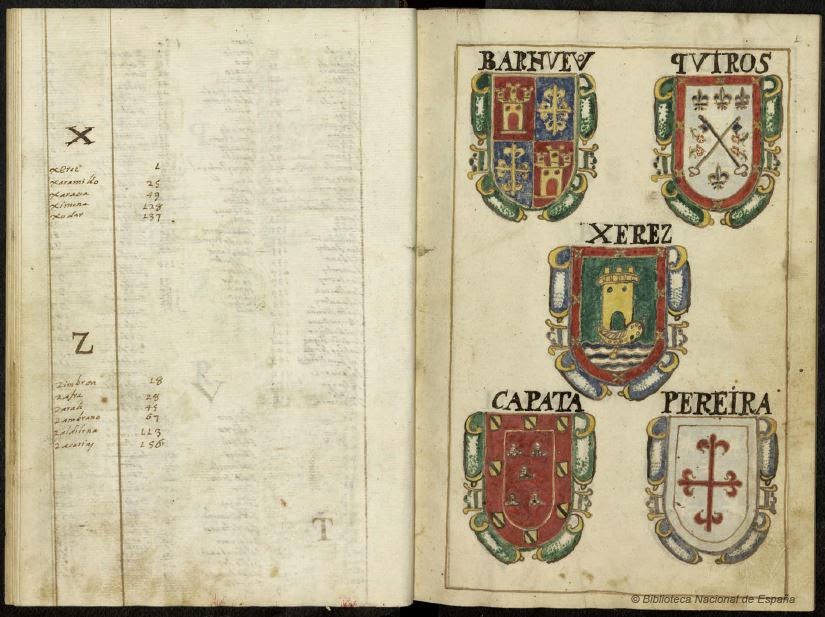
A valuable and, I believe, still little-known resource for Spanish heraldry and genealogy online are the manuscripts digitised through the Spanish National Library's 'Biblioteca Digital Hispánica' subsite, the number of which has grown steadily over the past couple of years. This site offers a veritable treasure trove of Spanish heraldic and genealogical manuscripts of diverse periods and provenance, and - it must be said - diverse quality as well. Given the dispersal of the records and registers of grants made by officers of arms under the Spanish crown, this collection may be the closest thing the nation has to the archives of London's College of Arms.

The site's use is straightforward enough; there is room for improvement in the cataloging and one senses that many Spanish antiquaries and even heralds have fallen into complete obscurity, a topic I have previously discussed with certain heraldists in my acquaintance and which is a striking contrast to the relative prominence still enjoyed today in our circles by their English counterparts of long ago, such as Dugdale. For example, they date a manuscript compiled by one Diego de Soto y Aguilar as 'Between 1700 and 1800?' when a quick Google places him at court in the reigns of Felipe III and Felipe IV, that is, the first half of the 1600s.

To sift through some of the manuscripts now available through this site simply go to http://bdh.bne.es/bnesearch/, click on Advanced Search and then fill in Heráldica or Genealogía as subjects, tick on the box for Manuscripts (see example here) and you're off to the races. If you're familiar with sites such as Gallica or Hathi Trust, this will seem comparatively easy to navigate, with thumbnails of each page appearing in a bar at the left as you go through each work.


Monday, 29 September 2014

Genealogical Oddities (XXXVII): A 19th Century Walloon Buried in Galicia

«Igrexa parroquial de Santiago do Carril-Vilagarcía de Arousa-Galicia-32» de Luis Miguel Bugallo Sánchez (Lmbuga) - Trabajo propio. Disponible bajo la licencia Creative Commons Attribution-Share Alike 3.0 vía Wikimedia Commons - http://commons.wikimedia.org/wiki/File:Igrexa_parroquial_de_Santiago_do_Carril-Vilagarc%C3%ADa_de_Arousa-Galicia-32.jpg#mediaviewer/File:Igrexa_parroquial_de_Santiago_do_Carril-Vilagarc%C3%ADa_de_Arousa-Galicia-32.jpg
The burial registers of the parish of Santiago de Carril, in the municipality of Villagarcía de Arosa, record the burial there on 25 December 1886 of 'Miguel Brayer Thonard', aged 65, a native of Ans in the province of Liège, Belgium, son of Pedro Miguel Brayer and Margarita Thonard. His marital status is said to be unknown; he is described as an 'Industrial', ie. a factory owner or other sort of manufacturer. I assume the French form of these names would have been: Michel Brayer (or Breyer?); Pierre Michel Brayer and Marguerite Thonard. Perhaps someone in Belgium knows who he was and why he was in Galicia.
SOURCE: Diocesan Archive of Santiago de Compostela, Registers of the Parish of Santiago de Carril, Burials 1879-1900, P. 87 verso

Thursday, 18 September 2014

Heraldry and Genealogy in the town of Llerena


 This town in Spain's westerly Extremadura region was the venue for a wedding I recently attended and while there I found some very appealing heraldic display, ranging from these beautifully painted 16th century arms in one of the chapels at the Nuestra Señora de la Granada church, to these more modern painted tiles at the arrivals door of the bus station, showing the arms of the town and of the region.

Some years ago I had occasion to work extensively with 16th century records of both of Llerena's churches as well as the notarial records for the same period, a wealth of documents that revealed a great deal about the families then prominent in the city - Chaves, Silíceo, Oliveros and Larios, among others. I look forward to eventually adding the photographs I obtained of the many armorial stones adorning some of the town's venerable old houses and will surely find these lineages and others represented in them.

Wednesday, 10 September 2014

Ancestry of Juan Miguez, 18th-century settler of Attakapas and New Orleans

Juan Miguez, who settled in North America's Attakapas County in 1778 and subsequently resided in New Orleans, has been widely listed as a native of 'San Salvador de Febra' in the Spanish region of Galicia, but this seems certain to be the result of a transcription error in the published version of the will left by Juan in New Orleans in 1800. Another publication, which transcribes the list of those who sailed aboard the brig 'San Josef', repeats the Febra error but at least gets us a bit closer to the Miguez' actual point of origin, by adding the placename Tuy.

A survey of the parishes in the Diocese of Tuy yields no Febra, but given the similarity of the uppercase letters T and F in old script it seems to me almost certain that Juan must have been native to the parish of San Salvador de Tebra, in the province of Pontevedra. As José's parents are named in his will, and the diocesan records for the 1700s are today kept at the Diocesan Archive of Tuy, it seems that his ancestry is simply waiting to be discovered.


If anyone can advise me as to specifically which publication was the source of the published transcript of Juan's will, I will happily update the reference below.


SOURCES: Will of Juan Miguez, 1800, extract submitted by Maurine Bergerie to a publication unknown; 'Historia de Alhaurín de la Torre en la Edad Moderna, 1489-1812', by José Manuel de Molina Bautista, extract online at http://www.thecajuns.com/malaguenos%20in%20la.pdf